
Bread And Tea, And Miserable Lives.

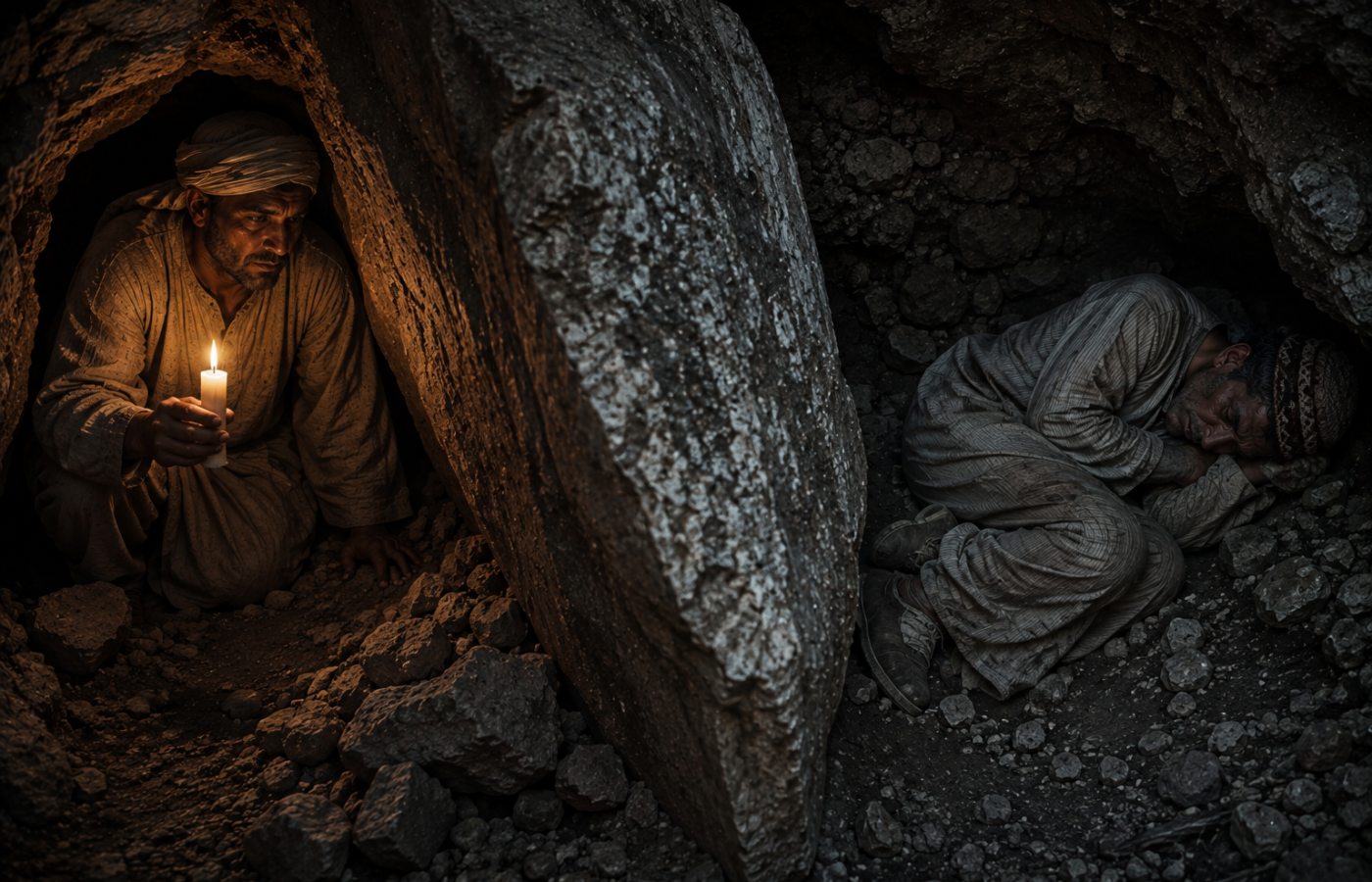
Alive in a cave, under a dome shaped by collapsed rocks, Hassan struggled to breathe. He struck a match and looked around – his bulgy dark eyes surveyed the jagged weeping walls. The match died at the tip of his calloused fingers. He struck another one, and this time he looked at his bruised knees. He could barely straighten his back without hitting his head against the ceiling. It was dark again, but this time he didn’t waste another match. He leaned against a damp rock, his chest heaving as he fathomed the possibility of another crash.
He heard movement somewhere, far or close; he couldn’t tell.
“Who… who’s there?” he called in a raspy voice.
“Mahmood… this is Mahmood. Who’s this?” The voice from the other side inquired.
“Mahmood! Mahmood! It’s me, Hassan,” he replied in a voice resuscitated with hope. He crawled on his hands and knees toward the voice until his head hit the wall. He put his ear to its cold surface. “Where are you?”
“I don’t know. It’s dark … it’s too dark,” said Mahmood. “Do you know if anyone else survived?” he asked.
“I don’t know. I shouted for help, but no one answered. They might be dead,” said Hassan before he burst into a hacking cough. “I thought you were dead, too,” he added.
“Dead?” repeated Mahmood, edging on his knees toward the voice. His fingers pressed against the wet ground. He then stretched his right hand up to touch the ceiling. “This place is small. Too small.”
“At least we’re alive and close to each other. There’s only one big rock between us. It’s probably the one rock that holds everything together.” Hassan guessed as he pushed against the wall, moaning from the pain he felt in his arm. “We have to wait for them. They must be searching for us.”
“You wait, Hassan. I’m not waiting for them. They don’t give a shit. You know how long it takes them to respond in this country,” said Mahmood.
“It’s not as bad as it used to be. We have to keep the faith no matter what.”
“Keep the faith.” snorted Mahmood. “I have no faith in this place. I only feel a slow, wrenching death. ”
“Pray, Mahmood. Pray! Miracles happen to those who believe. We’re not dead yet.”
“You pray,” said Mahmood in a cynical tone, “I lost faith in everything. In everyone. Look where we’ve ended up. A hole. At least it’s a grave our folks won’t have to pay for. Don’t tell me about a faith that changes no lives. We shouldn’t be in a fucking mine. All the diplomas we have earned, all the promises they told us are lies. We ended up in the desert, working like slaves. These people won’t respond; they will take their sweet time. They don’t need us. They’ve treated us as if we were a liability.”
“Accidents happen, Mahmood. They didn’t make it cave in.”
“They made the mine. Don’t tell me it was an accident… it’s been caving in for a long time.”
“There’s nothing we could do, man. We have to wait for them until they rescue us,” shouted Hassan.
They stopped talking for a while, each thinking of the life above, and of those they loved and those they hated. Mahmood thought of Malak, the girl he had once loved and now hated. After two years of applying for jobs and being turned down every single time, he decided to take any job.
“Don’t be picky, son. Take the first job you can get. Others waited long before you. They’re still waiting. Take anything you can get,” his father told him as he glanced at him. His eyes had long lost the luster of hope and pride he once saw in his eldest son.
“All the years I spent in college, Father. I have a Master’s degree that I can use. I should have a good job. I should be able to have my own home. I should be able to marry. Is that too much to ask?”
“What can I tell you, son? It’s Allah’s will. We should be grateful we have this little house… food and tea,” his father replied in a calm voice.
“It’s not Allah’s will. It’s their will to take away from us every simple right of living. And that’s all they tell you, it’s Allah’s will?” argued Mahmood as he leaned against the back of a chair that creaked from age. “They have fortunes, mansions, and power. And what do we have? Bread and tea. And miserable lives.”
“There’s a job, Mahmood. But I’m not sure it’s something you want to do.” His father offered reluctantly. “I have a friend, a supervisor in a mine hundred kilometers south of Tantan,”
“A mine? People die in mines, and they make less than what a beggar makes. It’s slavery, father,” Mahmood rejected as he stood up and started toward the door. He took a long walk that day. Returning home, he noticed Malak at the park, sitting on a bench with two of her friends. She saw him, stood up, and walked toward him. They went for a stroll, chatting. He then told her about the mine job.
“It’s not a bad idea,” she said. Mahmood stopped and looked at her for a second.
“You, too, want to get rid of me? I should just leave this fucking place,” he snapped as he kicked the dirt.
“You can do whatever you wish,” she declared, her eyes then landing on two youngsters engaged with soccer.
“You’re becoming more distant lately. What’s wrong?” he asked as he grabbed her arm. He looked into her hazel eyes; they were different and hardened.
“We can’t go on like this forever. My parents ask me every day. What’s he doing with his life? Why doesn’t he find a job? How could he marry if he still can’t have his own place? I’m tired of their questions, tired of everything.” She didn’t cry, but she looked at him regretfully. He let go of her arm, realizing a hidden truth in every word she said. He stood there looking at her in shock as if her concealed thoughts unraveled before his eyes.
“I understand. I… I don’t care,” he said.
“What do you mean you don’t care?”
“I don’t care if you want to be with someone else. I don’t care if you are already with someone. You’re a fucking liar, Malak,” he shouted at her as she stood before him like an Argan tree, unfazed by his accusations.
“You keep running, Mahmood. You blame everything on everyone else, but you don’t do anything to change your life. A mine will be a good place for you. One day, you’ll know who let go of the other, me or you.” She walked away from him like morning mist drifting over a plowed field. He watched until she disappeared. Forever.
“You know, Mahmood,” Hassan doubled over on the floor in a fetal position, his stomach screaming from hunger. “I once had a dream I was stranded in a place, dark and locked. I had nothing but a candle. Shrinking around me, the place got smaller until it turned into a coffin. You’re right, how can we change in a place controlled by cruel men, who make us like them, cold.” He paused for a moment. An eerie silence fell like a pall on a place already beaten to death. “I don’t want you to lose faith, Mahmood,” he added in a faint voice.
“I lost faith a long time ago. Don’t worry about me, Hassan. Worry about yourself.”
“I’m not worrying about us now. I worry about later.”
“There’s no later, Hassan. This is it.”
“But up there.”
“Up where? Where they sit worrying, smoking, and wondering how they could dig us out?”
“You know what I mean, Mahmood. I’m talking about heaven.”
“Worse than this place? You mean hell?” Mahmood started laughing. “Or do you mean the sun?”
“You lost your mind, Mahmood. We’re trapped, man. Pray for Allah’s grace, what will you lose?”
“You want me to play a fool with Allah. If God loves you, he’ll save you. But I doubt it. He would have to soften the hearts of those bastards, and you know how hard that is. God holds a mystic plan, divine and inscrutable, but the end of it lies as far as the end of the universe. Pray as much as you want, but don’t ask me to…”
“You make no sense. No sense. I am scared, man. And you’re making things worse. It’s best if you shut your mouth.”
“That’s the only thing I have left – a mouth that talks nonsense. Have I ever made sense? I guess not. Otherwise, I would have found a job and married the bitch and made her family happy,” said Mahmood as he lay down.
“I’m sorry, Mahmood. I didn’t mean to snap. I’m scared, man. I’m scared of dying. I don’t even know how long… how long we’ve been here like this. Forgive me, Mahmood. I want all those I hurt to forgive me. Say all you want,” Hassan put his face in his hands and mumbled a few words. “I have done bad things, Mahmood. You might have lost your faith, but you are a good man. I have always prayed, but I have done horrible things. Horrible things. Please, forgive me,” he implored as he wept.
“You didn’t do anything to me. I can’t forgive you for the things you’ve done to others. I guess you have a good reason to survive. I don’t. I don’t believe in forgiveness.”
Silence engrossed them in two different places, opening wide on a life that was drifting away. Hassan saw the horrified face of the man. One of his friends struck with a cudgel. They took his case, his money, and his address. It was not enough. They jumped on their mopeds and rode to the man’s house where his wife prepared dinner and waited. One of them showed up like a messenger from the husband. Hassan still remembered her horrified face. They pushed her inside as she screamed, begging for mercy. They tore her dress and stood with their shadows reflected on the walls, staring at her soft breasts. Hassan remembered her tearful eyes. They were kind, he thought then. One of his friends toyed with his knife before her eyes. She surrendered and stopped begging them.
Hassan remembered the harm he had inflicted on people he didn’t even know. He left the city after his heart opened up to God. He thought it was God’s will to guide him to light. Yet, guilt remained and settled heavily in his heart. It was not a matter of atonement. It was bigger than that. He had to suffer. He chose to work in a mine, where no one knew him.
“Is it enough to repent?” he asked in a breaking voice, not expecting an answer.
“You are a monster. And you’re not fooling anyone. At least, not me. Your love for God is a hypocrisy,” said Mahmood. “Your tears for Allah won’t do you any good. And if there’s hell, you’ll be the first to burn in it. Of all the men trapped dead in this mine, you deserve to survive and stay here by yourself, suffering for a long time.”
Hassan sat up, leaning his back against the wall. He held his hope in dwindling silence until he heard a rumble and a clink of chains and drilling. It was getting closer and louder. He felt the wall behind his back quaking. He now heard voices on the other side as if the hand of fate decided to pull him from his miserable life.
“We’re here… I’m right here,” he shouted as he embraced the rock.
“OK! Move away from the rock,” directed a hollow voice, echoing from the other side.
“You heard that, Mahmood?” he said. “I told you good people exist,” Mahmood didn’t reply.
The wall shattered under the drilling of a jackhammer, making a hole big enough for a man to go through. A man, holding a lamp, edged his soot-covered, leathery face. He smiled at Hassan.
“You are a lucky man,” exclaimed Haj Mansoor, the supervisor.
“Mahmood is alive. He’s trapped behind this wall,” said Hassan as he lifted his hand toward the dark end of the cave. Haj Mansoor looked at him with tired eyes.
“We found Mahmood dead. We already carried him up,” said Haj Mansoor, his eyes looking away from Hassan to one of his assistants. “All the other five men are dead.”
“He was talking to me. I swear he was talking to me just… now.”
“It’s impossible.” interrupted Haj Mansoor, “Hassan, they’re all dead. You are the only one left. You will be just fine.” The supervisor assured, staring at the gaunt face of Hassan, who stared back with eyes glazed and dark.