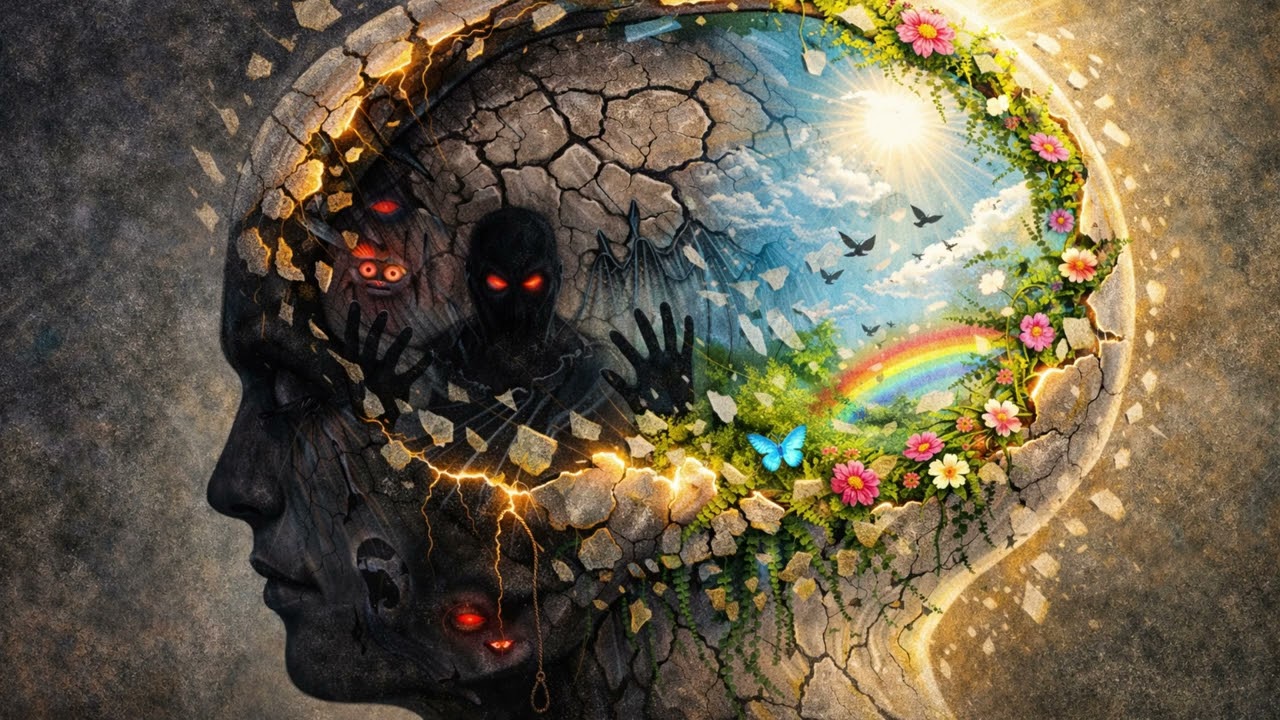
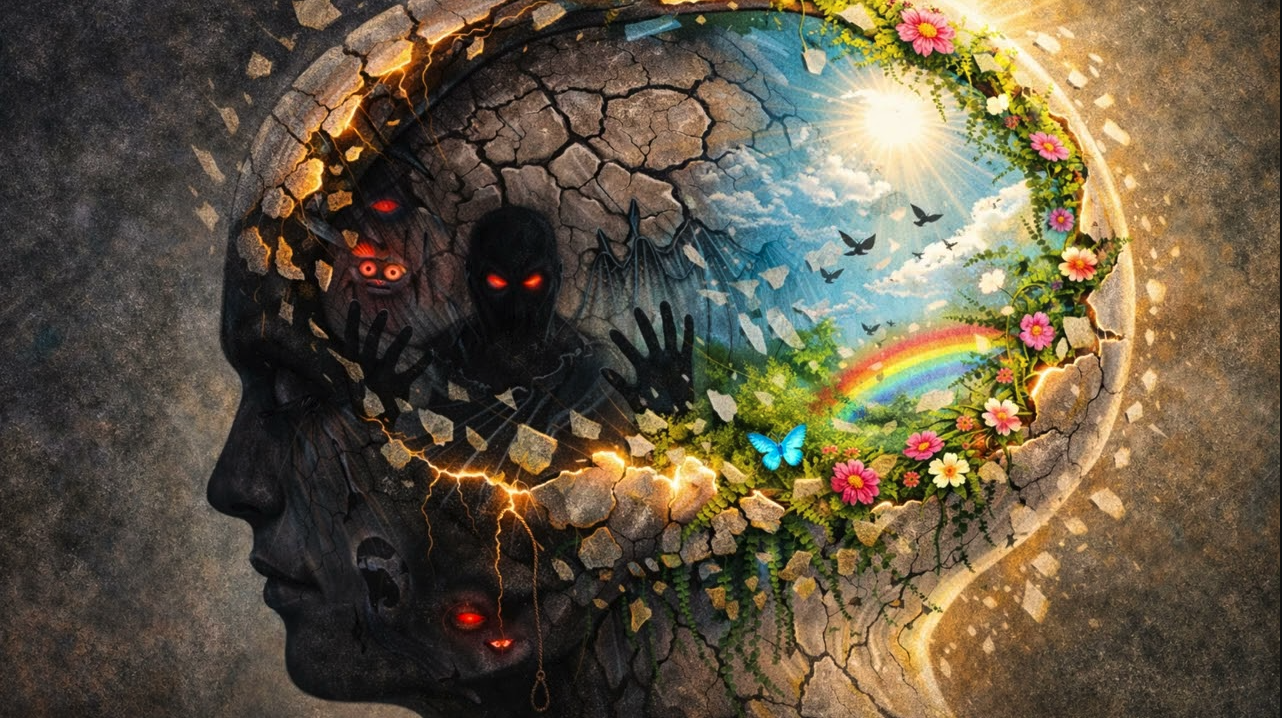
What If Psychosis Isn’t Broken, Just Overwhelmed?

For centuries, psychosis was feared, hidden, punished, or silenced. People who experienced it were labeled broken, dangerous, or lost. Modern psychology, psychiatry, neuroscience, and lived experience are slowly revealing a deeper truth: psychosis is not simply an illness to erase. It’s a state of mind that can break a person down — but under the right conditions, it can also reveal profound insight, creativity, and the possibility of healing.
Psychosis isn’t a single thing. It’s a spectrum — hallucinations, delusions, altered perception of reality, intense emotional states, a collapse of ordinary meaning. For the person experiencing it, the world feels like it has shattered. The familiar rules disappear. Time, identity, and certainty dissolve.
That’s terrifying, and the fear deserves to be acknowledged first. But fear isn’t the whole story.
Some of the greatest pioneers in psychology asked a radical question: what if psychosis is not just pathology, but also a human response to overwhelming pressure? What if a mind pushed beyond its limits enters a different mode of perception — not because it’s weak, but because it’s trying to survive.
Carl Jung was one of the first to approach psychosis with curiosity instead of condemnation. Jung experienced his own intense inner visions, voices, and symbolic worlds — later documented in The Red Book. Rather than suppress these experiences, he explored them carefully. He believed psychotic-like states could emerge when the unconscious overwhelms consciousness, but that these states also contain meaning, symbols, messages. Jung warned that without grounding, psychosis could destroy a person — but with structure, support, and integration, it could become a path toward deep psychological transformation.
Psychiatrist R.D. Laing challenged the medical model even more directly. Working with people diagnosed with schizophrenia, Laing observed that many had experienced severe emotional trauma, family conflict, or existential pressure. He suggested psychosis could be understood as a sane response to an insane situation — that the mind may fracture not because it’s defective, but because reality has become unbearable. Laing never denied suffering or romanticized illness. But he insisted on humanity: people in psychosis were not machines malfunctioning. They were human beings undergoing an extreme inner crisis.
Around the same time, Viktor Frankl — psychiatrist and Holocaust survivor — offered another essential piece of the puzzle. Frankl observed that meaning, not happiness, not comfort, but meaning, was central to psychological survival. In extreme conditions, including mental breakdown, those who could find meaning in suffering were more likely to endure and recover. Frankl didn’t focus specifically on psychosis, but his work laid the foundation for understanding recovery as a meaning-making process, not just symptom reduction.
Modern neuroscience adds another layer: psychosis involves altered connectivity in the brain. Certain networks become hyperactive while others lose regulation, which can lead to overwhelming perception, intense pattern recognition, and emotional flooding. From one angle, that’s dysfunction. From another, it’s excess sensitivity — a nervous system turned up too high. Sensitivity isn’t weakness. But without containment, it becomes pain.
This is where healing enters the conversation. Healing from psychosis doesn’t mean erasing the experience or pretending it never happened. Many people who recover say that trying to suppress or deny what they went through only deepens the suffering. Healing means integration — learning how to ground the mind, regulate the nervous system, and rebuild a stable sense of self while honoring the reality of the experience.
One of the most important developments in recent decades is the Hearing Voices Movement, pioneered by psychiatrist Marius Romme and researcher Sandra Escher. Instead of treating voices solely as symptoms to eliminate, they asked people what the voices meant, when they appeared, and how they related to emotional life. For many, the voices were connected to trauma, stress, or unresolved experience. By changing the relationship to the voices, people often reduce distress and regain control. This approach doesn’t reject medication or clinical care — it expands the frame. It recognizes that psychosis isn’t just chemical. It’s psychological, social, emotional, and existential.
Some people who experience psychosis go on to develop extraordinary creative abilities. That’s not romanticizing the illness — it’s acknowledging that a mind capable of that much intensity is also capable of that much depth.
This isn’t about romanticizing mental illness. It’s about restoring humanity to those who experience it. Whether you’re living with psychosis, supporting someone who is, or just wanting a more honest conversation about mental health — the point stands: the mind that breaks is still a mind trying to survive.
This content is educational and reflective, not medical advice. If you or someone you know is struggling, please seek professional support.
Related watch: VOW – Psychosis — Venom Words on YouTube